Its all about o level and a level physics students who are serious about their exams and seek online help.
Wednesday, August 31, 2011
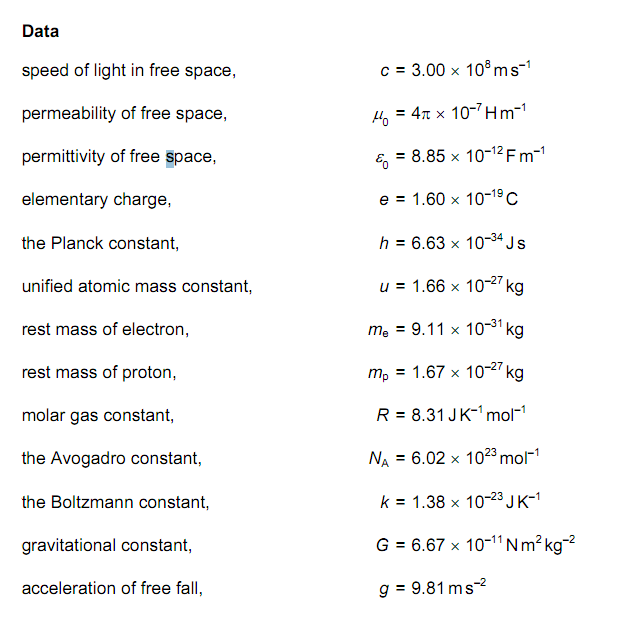
The important formulas and values that you must know for exams and to solve problems:
Please take note of the following because they will be useful in your exams:
Click on the images to see them clearly!
Problem on circular motion - solved
the question:
An object of mass 4 kg moves round a circle of radius 6 m with a constant speed of 12 m/s.
Read the question first :
Calculate
1.the angular velocity
Answer: angular velocity= speed/readius
= 12/6
= 2 rad/s
ok this is done with the formula : angular velocity= speed/readius
the next question is
2.the force towards the center (using a=v2/r)
Answer: force = m a
= mx v2/r ok
= 4x 122/6
=96N
Rotational motion Physics A Level
Todays topic is rotational motion .
Many students take this chapter to be a difficult one, but in fact it is a very easy one :the only thing we will have to do is to compare rotational motion with linear motion and then do the questions based on the formulas we are going to derive:
Torque is considered as the force here and alpha that is angular acceleation is considered to be acceleration.
Torque is considered as the force here and alpha that is angular acceleation is considered to be acceleration
Torque= force x radius of circle
Rotational motion Physics A Level
Todays topic is rotational motion .
Many students take this chapter to be a difficult one, but in fact it is a very easy one :the only thing we will have to do is to compare rotational motion with linear motion and then do the questions based on the formulas we are going to derive:
Torque is considered as the force here and alpha that is angular acceleation is considered to be acceleration.
Torque is considered as the force here and alpha that is angular acceleation is considered to be acceleration
Torque= force x radius of circle
Many students take this chapter to be a difficult one, but in fact it is a very easy one :the only thing we will have to do is to compare rotational motion with linear motion and then do the questions based on the formulas we are going to derive:
Torque is considered as the force here and alpha that is angular acceleation is considered to be acceleration.
Torque is considered as the force here and alpha that is angular acceleation is considered to be acceleration
Torque= force x radius of circle
Tuesday, August 30, 2011
Free Fall
Free Fall
A body moving freely under gravity has a constant acceleration of 9.8 m/s2 downwards towards the centre of the earth. This can be proved by the following:
mg=ma (during free fall)
Here m gets cancelled out,
g=a
As we already know that the force gravity on 1 kg mass is 9.8 N ,therefore the acceleration of free fall is also 9.8 m/s2 .
It is evident from the following that a body moving freey under gravity , increases its speed by 9.8m/s every second.
A body moving freely under gravity has a constant acceleration of 9.8 m/s2 downwards towards the centre of the earth. This can be proved by the following:
mg=ma (during free fall)
Here m gets cancelled out,
g=a
As we already know that the force gravity on 1 kg mass is 9.8 N ,therefore the acceleration of free fall is also 9.8 m/s2 .
It is evident from the following that a body moving freey under gravity , increases its speed by 9.8m/s every second.
Free Fall
Free Fall
A body moving freely under gravity has a constant acceleration of 9.8 m/s2 downwards towards the centre of the earth. This can be proved by the following:
mg=ma (during free fall)
Here m gets cancelled out,
g=a
As we already know that the force gravity on 1 kg mass is 9.8 N ,therefore the acceleration of free fall is also 9.8 m/s2 .
It is evident from the following that a body moving freey under gravity , increases its speed by 9.8m/s every second.
A body moving freely under gravity has a constant acceleration of 9.8 m/s2 downwards towards the centre of the earth. This can be proved by the following:
mg=ma (during free fall)
Here m gets cancelled out,
g=a
As we already know that the force gravity on 1 kg mass is 9.8 N ,therefore the acceleration of free fall is also 9.8 m/s2 .
It is evident from the following that a body moving freey under gravity , increases its speed by 9.8m/s every second.
Monday, August 29, 2011
Physics A Level formulas for motion.
It is very advisable to study and learn the following formulas by heart:
v= s/t
a= v/t
v= s/t
a= v/t
Subscribe to:
Posts (Atom)